

Articles
How Did the Early Church Discern the Voice of God?
September 15, 2026
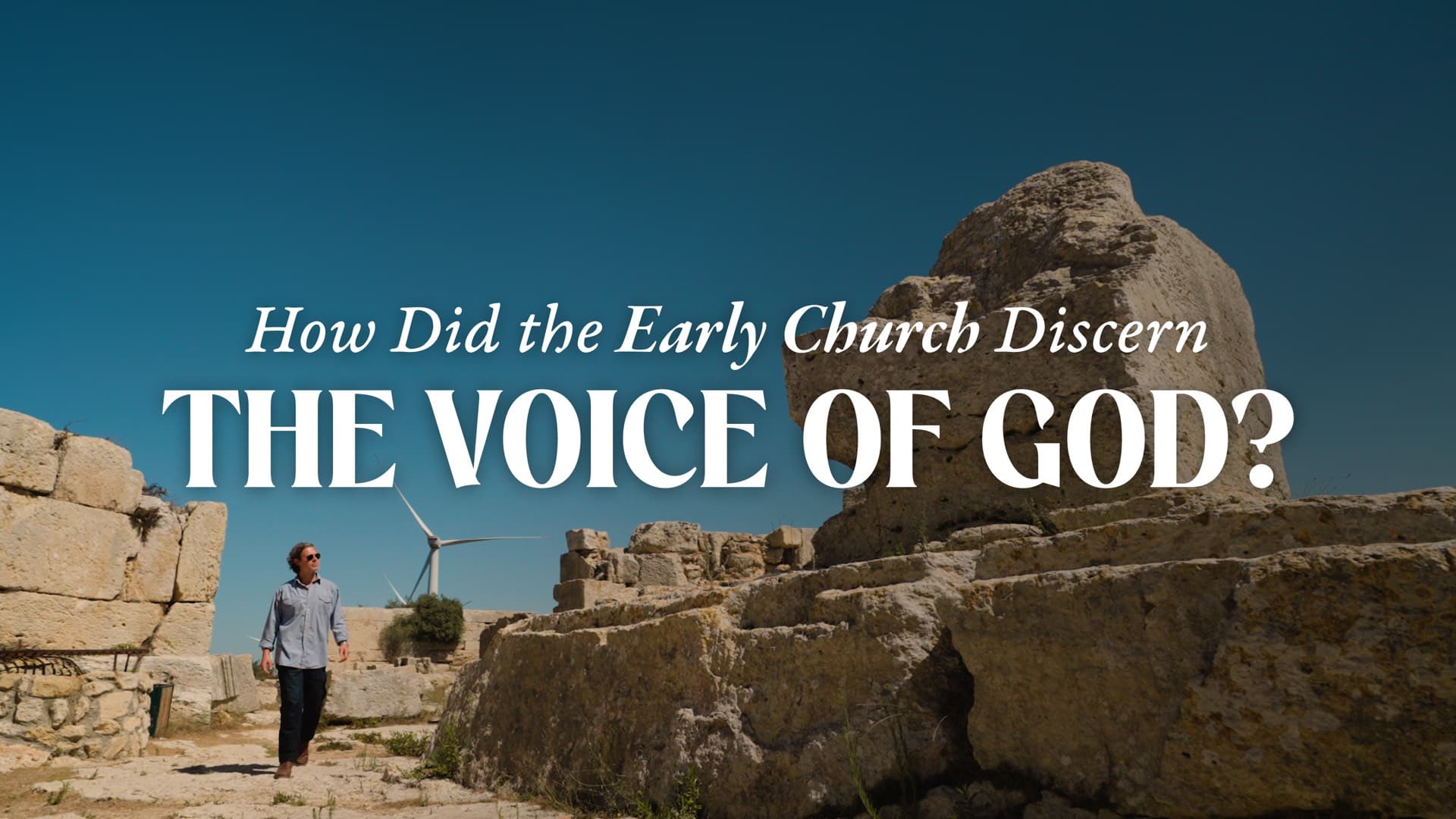
How do you know when God is speaking—and what do you do when you believe you’ve heard Him?
For the earliest Christians, this wasn’t an abstract theological question. It was survival. There was no completed New Testament sitting on a shelf. No leather-bound Bible to open when the church faced a crisis. The Gospels and apostolic letters were still being written, circulated, and collected. Yet decisions had to be made. Where should the gospel go next? How should the church respond to suffering? What did the death and resurrection of Jesus mean for Gentiles entering the family of God?
The young church in Antioch was learning to follow Jesus in real time. And into that uncertainty walked a prophet named Agabus.
A Prophet Arrives in Antioch
Acts 11 tells us that prophets came from Jerusalem to Antioch. One of them, Agabus, stood before the church and delivered an alarming message:
“Through the Spirit he predicted that a severe famine would spread over the entire Roman world” (Acts 11:28).
Early church tradition, similar to Barnabas, would later associate Agabus with the larger group of disciples sent out by Jesus in Luke 10, though the New Testament itself doesn’t make that connection. What Scripture does make clear is that the church took his prophetic warning seriously. But perhaps the most interesting part of the story isn’t simply that Agabus predicted something correctly. It’s what the church did next. They responded.
“The disciples, as each one was able, decided to provide help for the brothers and sisters living in Judea” (Acts 11:29)
They didn’t treat prophecy as spiritual entertainment. They weren’t disillusioned by false words. They didn’t gather around Agabus because knowing the future made them feel important. Revelation produced responsibility. If God was warning them about suffering that was coming, then they would prepare to become part of His provision when it arrived. So this young, culturally diverse church in Antioch gathered resources and sent relief to believers hundreds of miles away. Prophecy became generosity. And revelation became action. Hearing God became loving people.
See how moments of prophecy and revelation shaped the story unfolding in Antioch in Cities of the First Christians: Antioch, a five-part series with Dr. Matthew Larsen. Explore the series →
A Church Learning to Listen
This is easy for modern Christians to miss.
The world of the early church was saturated with God’s active presence. The book of Acts contains dreams, visions, prophetic words, angelic encounters, divine direction, and moments where the Holy Spirit speaks with remarkable specificity. For them, the resurrection of Jesus and the outpouring of the Spirit at Pentecost meant something had fundamentally changed.
Peter had already announced it by quoting the prophet Joel, “I will pour out my Spirit on all people. Your sons and daughters will prophesy” (Acts 2:17).
God’s presence was no longer confined to a temple. His Spirit had been poured out upon His people. And Antioch became one of the places where we see what that looked like. But prophetic guidance wasn’t the only kind of revelation shaping this church.
There was also Paul.
Paul’s Revelation Changed the Table
Paul was wrestling with one of the most explosive questions imaginable for the early church: What must a Gentile do to belong to the people of God? Did Gentile converts need to adopt Jewish practices and keep the Mosaic law? Or was faith in Jesus enough? For Paul, the answer wasn’t merely the result of clever theological reasoning. He speaks repeatedly about revelation. In Galatians, Paul says the gospel he preached was not something he simply received from another person: “I received it by revelation from Jesus Christ” (Galatians 1:12).
Later, describing a journey to Jerusalem, Paul says he went “in response to a revelation” and presented the gospel he was preaching among the Gentiles. Paul became convinced that Gentiles did not need to become Jews before they could become Christians. That conviction would reshape Christianity. And Antioch became one of the places where its implications were worked out in real relationships, around real tables, between people who had been raised in very different worlds.
The early church wasn’t merely asking, “What do we think?” They were asking, “Where is the Spirit leading us?”
Follow Paul and the early church as they navigate the questions and decisions shaping Christianity in Cities of the First Christians: Antioch. Watch Antioch on QAVA →
When God Speaks, Something Should Move
We live in a very different moment than the church in Antioch. We possess something those early believers did not yet have: the completed Scriptures. And that is an extraordinary gift.
Scripture gives us the authoritative revelation of who God is, what He has done in Christ, and what faithfulness looks like for His people. Every impression, prophetic word, prompting, dream, or claim of divine guidance must therefore be brought underneath the authority of Scripture.
The Spirit of God will never contradict the Word He inspired.
And this matters because few phrases can become more spiritually dangerous than an unaccountable, “God told me.” This should never become a way of ending a conversation, bypassing wisdom, resisting accountability, or giving divine authority to our own desires. The New Testament itself tells believers to test what they hear, to discern together, and to hold fast to what is good. But there is an equal and opposite danger.
We can become so concerned about getting “God told me” wrong that we stop expecting God to lead us at all. We can possess the Scriptures and still cultivate very little dependence upon the Spirit. We can know the biblical commands, understand the theology, study the original languages, and still approach the Christian life as though God has given us a book and then stepped away.
But that isn’t the Christianity we encounter in Acts. The early Christians were deeply dependent upon the active presence of God. They prayed. They fasted. They listened. They discerned together. They paid attention to the movements of the Spirit. The Scriptures and the Spirit were never meant to become competitors. The Spirit inspired the Word, and the Word teaches us how to recognize the Spirit. The Spirit forms within us the sensitivity, courage, and obedience to actually follow Him.
Because Christianity isn’t simply learning what God said. It is learning to walk with the God who still leads His people today. There are thousands of decisions Scripture will not make specifically for you. What city should you live in? Which opportunity should you pursue? When should you stay? When should you go?
The Bible gives us the world in which those decisions must be made. Wisdom and Christian community help us discern them faithfully. And within those boundaries, we remain dependent upon the Spirit.
That requires a posture that is increasingly rare in our age. And that posture is attentiveness.
The willingness to slow down long enough to ask, Holy Spirit, what are You doing here?
And then the courage to obey when His leading is consistent with His Word, confirmed through wisdom, and discerned in community.
That is what we see in Antioch. Agabus spoke. The church discerned. And generosity followed. When God spoke, something moved.
Maybe that is the invitation Antioch leaves with us: to become people so saturated in Scripture that we can recognize what sounds like Jesus—and so dependent upon the Spirit that we are still listening for His leading.
Because the goal of the Christian life isn’t simply to know what God has spoken. It is to become the kind of people who know His Word, recognize His voice, and have already decided that when He leads, we will follow.
Go Deeper Into the Story of Antioch
Continue exploring the people, places, and events that shaped the early church in Cities of the First Christians: Antioch, a five-part series with Dr. Matthew Larsen filmed on location in ancient Antioch. Explore the series alongside Scripture and reflection questions that help you dig deeper.
Articles & Devotionals



Ready to Go Deeper? Start Free.
$9.99/month
$119.88/year
- 7-day free trial
- 150+ hours of Bible studies, series, & documentaries
- New content added monthly
- Guided reflections & daily tools
- Ad-free platform
$89.99/year
Save 25% vs. monthly
- 7-day free trial
- 150+ hours of Bible studies, series, & documentaries
- New content added monthly
- Guided reflections & daily tools
- Ad-free platform
Try it free. Cancel anytime.